FIGHTING THE CLIMATE DISINFORMATION WARS WITH DR. MICHAEL MANN

Have you noticed that the hotter it gets, the more wildfires spark, the more climate disinformation floods social media? This is especially true right now on Elon’s upside-down X, where carbon pollution is good and oil/coal/gas are tickets to prosperity and a greener earth. Shame on Elon, who knows better.
My Fenton Forecast guest this week, climate scientist Dr. Michael Mann of the University of Pennsylvania, has been fighting propaganda and falsehood for decades.
In 1998, Mann and colleagues published what became known as the “hockey stick” graph. It showed centuries of a stable climate in the northern hemisphere, with a slight cooling trend, and then a rapid almost straight line up in hotter temperatures starting in the late 1800s with the Industrial Revolution. A later version for the globe, going back 2000 years, is below.
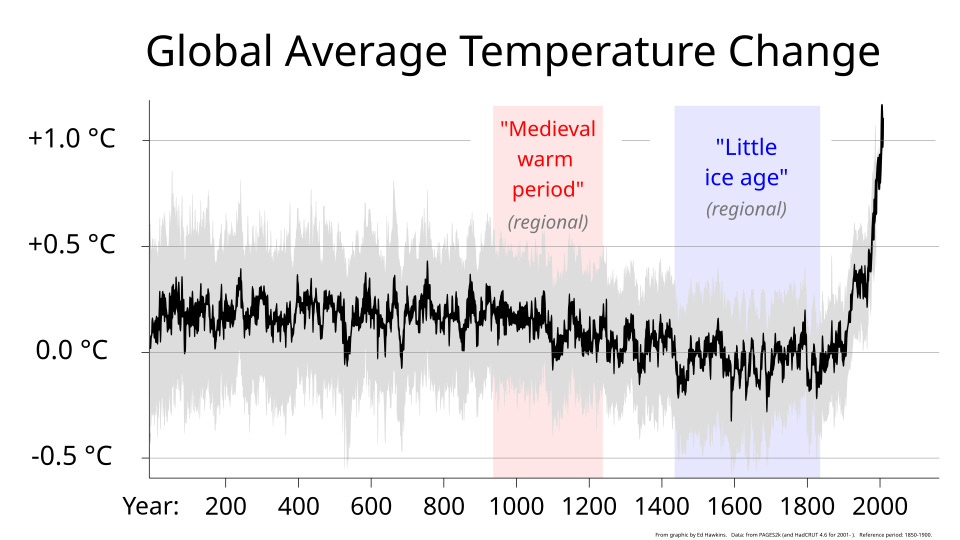
This simple graph drove the fossil fuel industry NUTS. Recognizing its clear, simple, symbolic power, the oil/coal and gas companies went into overdrive trying to discredit the graph — by trying to discredit Dr. Mann. I mean, who can say the planet isn’t over-heating quickly after seeing that graph? Seeing, they understood, is more powerful than hearing or reading.
At the time, Mann was a professor at the publicly funded University of Virginia. The industry’s paid political prostitutes started harassing Mann and the University, demanding his emails and more. It was a full-on campaign. To this day, right wing disinformers still attack the hockey stick.
But it didn’t work. Mann prevailed, and every major scientific institution in the world, including the U.N. Intergovernmental Panel on Climate Change, accepts the accuracy of the graph.
Meanwhile, right wing pundits kept going after Mann. But he fought back. Mann won a libel suit against the “conservative” (meaning supporting planetary destruction) National Review for defaming him.
Mann is the author of essential books including “The New Climate Wars,” “Our Fragile Moment” and “Science Under Siege” with Dr. Peter Hotez.
Frequently on cable tv, Mann continually explains the link between pollution and extreme weather. On social media @michaelemann slays dragons daily. On Instagram he’s @michaelmannscientist — please follow him.
Mann explains what truly uncharted territory we are in. As climate deniers like to point out, “the climate has changed before.” It is true — but that was millions of years before human civilization, which depends on a stabile climate for agriculture. Those past changes from natural earth orbital cycles, volcanoes, etc were SLOW, over 100 million years. Whereas we have doubled carbon dioxide in the atmosphere from industrial activity in just 100 years, with most of it in the past 30. How fast will that collapse the ice sheets, submerging our cities underwater? Nobody can say if it will take 75 or 200 years from now. From a moral point of view, of course, it makes no difference. As Dr. James Hansen, the Godfather of climate science likes to say, “once the ice sheets start to move, we have no way of stopping them.”
Certainly, recent weather, and the upcoming super El Niño, are like a trip through the Book of Revelation, as Al Gore likes to say. Yet you wouldn’t know the cause is burning oil, coal and gas if you follow most of the American media. When it comes to climate, the media is an ostrich with its head in the sand. Including, sadly, the New York Times Editorial Board, which still says nothing about the emergency we are facing. The 3 tv networks — which are big on TikTok, by the way — also rarely or never explain how pollution is creating extreme weather. History will not judge them well.
Mann talks about how we face “plutocrats, petrostates and propagandists” in the fight for a liveable earth. He adds, “and the press hasn’t necessarily been our friend either.”
Doomerism, however, is something Mann rejects. We are still within a window where the very worst impacts of climate change can be avoided. Rapidly phase out and then stop burning fossil fuels, and temperatures will stop rising, he explains. We will then have to take some of the pollution down to restore a livable climate.
Mann minces no words in describing the culpability of the fossil fuel executives who are knowingly destroying climate stability. “Well, by some measure, there are crimes against humanity, and there’s arguably an even higher level of crime, crime against the planet. Because that’s everything. It’s not just humanity, it’s the only livable planet we know of in the universe. They are compromising that planet. It’s hard to imagine a greater crime than that, isn’t it?”
You can watch my interview with Michael Mann on Substack or YouTube, or listen on Apple Podcasts, Spotify or wherever you get your podcasts. Your feedback is always welcome please write to us hello@fentonforecast.com
For a livable, flourishing, prosperous Earth,
David
.
Transcript Below
Episode Transcript: Dr. Michael Mann on Climate Change
Guest: Dr. Michael Mann, Professor of Earth and Environmental Science, University of Pennsylvania; author of Our Fragile Moment and Science Under Siege
DAVID FENTON: Michael, thank you so much for being a guest on the Fenton Forecast.
DR. MICHAEL MANN: Thank you, David. Good to be with you.
DAVID FENTON: And here we’re going to talk about a literal forecast, a forecast of what the weather’s going to be like in the future, depending on what we do or don’t do, right?
DR. MICHAEL MANN: Yeah.
DAVID FENTON: You’re on cable news quite frequently, and you have to give very clipped, short answers and answer a lot of questions that aren’t always the ones you want to be asked. So I wanted to start out and ask you, what do you most want people to know? Here now you have a longer format. You can dictate the terms of your own engagement. What is it that you most want people to understand and to know for a lay audience?
DR. MICHAEL MANN: Yeah, thanks. It’s always nice to do these longer format interviews where you really can get into all the nitty gritty details. But in short, it’s not hard. What we need people to know is that climate change is real. It’s caused by human activity, particularly the burning of fossil fuels and the generation of carbon pollution in the atmosphere. It’s warming the planet and it’s leading to more extreme weather events and all sorts of impacts that aren’t far off in the future. They’re here and now. And it’s a question of how bad we’re willing to let it get at this point.
DAVID FENTON: Right. Now, you very understandably have been trying to stop a sense of so-called doomerism, of people feeling hopeless and that it’s too late and there’s nothing we can do. And at the same time, you want people to know that we’re taking enormous risks unless we get the perpetrators of this problem under control. So how do you thread that? How do you tell people how bad it’s going to be if we don’t rein them in and act and also make sure people understand that there’s a lot we can do?
DR. MICHAEL MANN: Yeah, as I like to say, it’s about conveying both urgency and agency. Urgency. As we just said, we are witnessing now the catastrophic consequences of the warming of the planet caused by our continued reliance on fossil fuels. And we need to move as quickly as possible away from fossil fuels. As I like to say, if you find yourself in a climate hole, stop digging fossil fuels and burning them. That’s the urgency. The agency, it is not too late. The science tells us if we stop putting carbon pollution into the atmosphere, the warming of the planet will actually halt fairly quickly. The warming of the planet will, you know, the planetary temperatures will stabilize very quickly once we bring carbon emissions to zero. So there’s an immediate and direct consequence of our efforts to decarbonize our world.
DAVID FENTON: So certainly are seeing the effects. As we speak here in mid-March, there’s a massive heat wave bearing down on the West, like nothing that’s been seen before. I think you certainly expect to see more of that, don’t you?
DR. MICHAEL MANN: Yeah, and I’ll actually be talking on cable news about that later on today. It seems that the only opportunities we have these days when it comes to mainstream media coverage is these extreme weather events. And it’s important for us to take advantage of that and connect the dots for the public so that they understand that this isn’t just about polar bears off in the Arctic decades from now. It’s about the damage and indeed deaths that are now occurring because of these catastrophic events that have been increased in frequency and severity by human-caused climate change. Right now we’re seeing this unusual pattern in the atmosphere, this pattern of the jet stream where you have a big high-pressure system out west that’s giving them that unprecedented heat so early in the spring. And at the same time, we see sort of the converse of that wave disturbance in the atmosphere where the cold air then is crashing down and we’re seeing a polar vortex event in the center of the country. Here in Philadelphia, Pennsylvania, the temperatures dropped about 40 degrees over the course of 24 hours just the other day as that cold air moved in.
Now, there’s some science that suggests, you know, not just that the planet is warming. And so we expect, you know, to see more of that record heat like we’re seeing out west right now. That is one of the things we expect to see. But there’s also some indications that we may see a more wavy jet stream. And so larger extremes at both ends of the spectrum, extremes of drought and flooding, as well as extremes of heat and cold.
DAVID FENTON: Yeah, and some people have called that global weirding.
DR. MICHAEL MANN: Yeah, that’s right. And the science increasingly supports that there’s a connection. It’s still being debated. You know, there are scientists of good faith who have different views about that particular aspect of climate change. But if you ask me, the evidence is increasingly coming in in favor of the warming of the planet, changing the pattern of the jet stream in a way that gives us more of these persistent weather extremes.
DAVID FENTON: A kind of destabilization.
DR. MICHAEL MANN: Yeah, you could think of it that way. Yeah.
DAVID FENTON: And we’ve had a relatively stable climate for most of human civilization. At least this is what allowed agriculture to flourish. And so now, because of the burning of fossil fuels, we’re destabilizing that stability to great peril. And, you know, of course, many people get confused by the intentional disinformation that the fossil fuel industry spreads through its propaganda apparatus and its apparatchiks. And of course, the most common reaction that you get when people want to not accept this is, well, the climate has always changed before. And of course, that’s true. So how do you explain to people in simple terms that, yes, that’s true, but this time it’s different?
DR. MICHAEL MANN: Yeah, well, that was the... of my last book, not the current book that you see behind me, but my last book, Our Fragile Moment, which is about the lessons that we can actually learn about the climate crisis from studying Earth history over not just millions, but billions of years, all the way back to sort of the origins of our planet.
And it is, of course, true that there have been times when the planet was warmer than it is today. And we know that that’s because there were higher levels of greenhouse gases in the atmosphere, the very greenhouse gases that we are spiking today from fossil fuel burning. Here’s the difference. If you go back 100 million years, so you’re back into sort of the mid-Cretaceous period, the planet was warmer than it is today. There was no ice at the poles. That unusual warmth was associated with very high levels of carbon dioxide in the atmosphere, probably more than a thousand parts per million in the atmosphere. So nearly three times what there is today in the atmosphere. And now here’s what happened. Over a hundred million years, nature through natural... like plate tectonics and weathering processes that regulate the concentration of carbon dioxide in the atmosphere over very long timescales, over 100 million years, the Earth system took that carbon out of the atmosphere and buried it beneath the surface. That’s what produced fossil fuels. What are we doing today? We’re taking all of that carbon that nature buried over 100 million years, and we’re putting it back into the atmosphere. But not over 100 million years, over 100 years.
DAVID FENTON: Right.
DR. MICHAEL MANN: A million times faster. And there’s simply no evidence that we or any other living things can deal with changes that are that rapid. That’s the problem. The rate at which we are moving out of that envelope of stability that, as you say, we developed this civilization that today serves more than 8 billion people on this planet. And it is fragile. It is dependent on the stability of our climate, and we are destabilizing the climate, as you say.
DAVID FENTON: You know, first of all, I want to thank you for talking to me about this, because as I think you know, I didn’t finish high school. And I didn’t go to college for a day.
DR. MICHAEL MANN: Some of the smartest people didn’t finish high school or college. I believe Einstein, I forget.
DAVID FENTON: Well, I wouldn’t go quite to that level, but... And I think it’s useful so you can try to talk to me as a high school dropout in a way that everybody can understand. And I also want to say I’m very conscious of your — and I very much agree with you that we cannot spread doomerism. And at the same time, we need people to understand this. So my understanding is the amount of carbon dioxide that’s in the atmosphere today, it’s about, what, 440 parts per million?
DR. MICHAEL MANN: Yeah. Oh. Today, it’s about 425 or 426 parts per million.
DAVID FENTON: That’s right.
DR. MICHAEL MANN: By the way, I misspoke. Einstein did have an advanced degree.
DAVID FENTON: Thank you.
DR. MICHAEL MANN: But, perhaps the greatest oceanographer in the history of our science, Henry Stommel, only had a bachelor’s degree. He didn’t have a PhD.
DAVID FENTON: Well, I don’t have a high school diploma, so we’re really in a special category here.
DR. MICHAEL MANN: There’s a hierarchy here, though.
DAVID FENTON: So my understanding is that, tell me if I have this right, that the last time in Earth’s geologic history there was that much carbon dioxide in the atmosphere, the 424, the mid-Pliocene, I believe it’s called, the seas were between 16 and 80 feet higher than they are today. So does that mean if we don’t do something dramatic soon, that over the next period, who knows how long, the seas could get that high again?
DR. MICHAEL MANN: Yeah, they certainly could. The mid-Pliocene, if you like, is perhaps our best analog for what the world would look like if we were to sustain the levels of carbon dioxide that exist in the atmosphere for perpetuity. So in that case, those CO2 levels were high for many thousands of years, for millions of years. If you keep them that high, eventually the climate system will fully adjust to that high level of carbon dioxide and you’ll melt the ice sheets and you’ll move forests and you’ll fundamentally change the planet, the face of the planet. We haven’t held CO2 concentrations that high for nearly as long a period of time at this point, right? We’ve only just reached them. And so the implication is that not only do we have to stop increasing the level of CO2 in the atmosphere. But ultimately, we’re going to have to bring it back down. Yeah, sure. Because if it’s sustained at this level, ultimately, we could see, as you say, tens of feet, tens of meters of sea level rise if the climate system were to fully adjust to the level of CO2 that exists in the atmosphere right now.
DAVID FENTON: Now, you did work showing that by the end of this century, the seas could be six feet higher. Is that right?
DR. MICHAEL MANN: Yes, we’ve done some work looking, in fact, at the combined impact of sea level rise and the intensification of hurricanes and the implications that would have for sort of massive flooding events along the east coast of the U.S., like what we saw with Superstorm Sandy in New York City.
DAVID FENTON: Right. It goes together because as we warm the planet, the ice melts, raises sea levels, but we also get more intense hurricanes that cause stronger storm surges. So again, I’m going to get to the positive side in a minute, I promise.
DR. MICHAEL MANN: It’s sounding pretty bleak, isn’t it?
DAVID FENTON: No, I’m very aware of this, believe me. And I’m optimistic, which is why I work on this. If I wasn’t optimistic, I would give up like you would probably.
DR. MICHAEL MANN: I think that’s true with most, if not all of us who are in this field and trying to communicate.
DAVID FENTON: We have a solvable problem, although we do have a small group of very evil, greedy people that we’re going to have to deal with, which we’ll get to in a minute.
DR. MICHAEL MANN: I’m not sure they’re that small.
DAVID FENTON: Well, ultimately, well–
DR. MICHAEL MANN: Let’s say we’ve got a dozen, a dozen bad actors who are ruining the planet. Yeah.
DAVID FENTON: Yeah. That’s small. Yeah. Okay. So before we get to how we’re going to solve this, which we are, let’s say, let’s take Miami Beach. Now, as I understand it, Miami Beach will flood from below because it’s built on porous limestone, I believe, former coral rock.
DR. MICHAEL MANN: Yeah.
DAVID FENTON: So what’s a conservative range of time by which people are going to have to leave Miami Beach? Is it 20 years? Is it 30 years? Is it 60 years? It certainly isn’t much longer than that, is it?
DR. MICHAEL MANN: Yeah. I mean, you know, there are. There are questions about how much additional sea level rise we are now committed to. And those questions are difficult to answer because it depends on the complex nature of ice sheets and how quickly they can disintegrate. And one of the lessons that we’ve learned over the last decade or two is that ice sheets are actually more dynamic than we used to think, than the ways that we used to model them. And because of that, substantial sea level rise could occur earlier than we once thought. We could, for example, by the end of this century, see as much as a few feet of sea level rise, if we continue with business as usual, if we don’t get our act together, and a few feet of sea level rise would be enough to potentially, you know, inundate large parts of southern Florida, particularly during those storm surge events to the point where we’re talking about managed retreat, literally moving away from the coast.
DAVID FENTON: So on another part of the spectrum, take extreme heat and water shortages. So let’s just look at Phoenix, Arizona, and Las Vegas. What’s a possible dependable prognosis range for what’s going to happen there over the next 50 years?
DR. MICHAEL MANN: Yeah, and I actually tell a story in Our Fragile Moment about my own experiences in Phoenix, Arizona, when my family just returned from the Grand Canyon. We stayed at a hotel right at the Phoenix airport. We were going to fly out the next morning. You may remember this day. It was in June 2018. This was the day that planes couldn’t take off from the Phoenix airport because it was so hot. They couldn’t get enough lift. And that’s the night that we were at the Phoenix airport. And my daughter and I went swimming in the outdoor swimming pool that afternoon, scalding hot. And the swimming pool felt like a hot tub. And we got out after maybe 20 minutes or so, retreated to the air-conditioned hotel room. That night, my wife and I were awakened at about 3 o’clock in the morning. Our daughter couldn’t breathe. We had to take her to the emergency room, the nearest emergency room, and they put her on a breather, whatever you call that.
DAVID FENTON: Ventilator.
DR. MICHAEL MANN: And they identified that she was suffering from, I guess what’s called sort of conditional asthma. She doesn’t normally have asthma, but during acute sort of periods of stress, for example, when it’s that hot in Phoenix, turns out you have very high levels of surface ozone pollution and so there were record levels of ozone pollution in Phoenix that day and she nearly died because of it. We were looking at the potential loss of our daughter. And so that is when climate hit home for me. It directly impacted me and my family. That was a result of the unprecedented heat and that’s just one story. It’s my own story. There are millions of other stories like that.
DAVID FENTON: And if we don’t turn this around, it’s, you know, as I like to say, if you trap heat on Earth, it gets hotter. And every day we’re trapping more heat on Earth because that’s what the gases do. That’s the blanket of pollution, right, that we’ve put around the Earth. It gets thicker every day, so it gets hotter and hotter.
DR. MICHAEL MANN: It’s not rocket science, except for the fact that the Air Force actually had to understand the greenhouse effect in the atmosphere to design heat-seeking missiles properly.
DAVID FENTON: Right. So tell me. What makes you angry about this situation, Michael?
DR. MICHAEL MANN: Well, you know, what you’ve already alluded to. Literally, you can count, indeed, on the fingers of your two hands, the number of bad actors, of plutocrats who are basically funding the infrastructure that promotes misinformation and disinformation about climate change that pollutes our public sphere, that buys out politicians, and prevents us from acting on what is the defining challenge of our time. That should upset everybody.
DAVID FENTON: Yeah, and they came after you big time, which I’d like to talk about in a minute.
DR. MICHAEL MANN: I hardly noticed. They attack me so often, I hardly even notice anymore.
DAVID FENTON: Well, that’s another kind of denial, I think.
DR. MICHAEL MANN: It’s actually a line from the Blues Brothers. Sorry.
DAVID FENTON: That’s good. You know, when I talk about this, people accuse me of being like a completely crazy radical. But I believe this is an objective, accurate statement that there is a very small group of fossil fuel executives and some of their bankers and some of their... It’s a small group. And they are determined to burn every last drop of oil, coal, and gas to make as much money as they possibly can, while knowing, as they have for 50 years, that they’re going to destroy the life support systems of the earth, and they don’t care. There is a small cabal, the greediest that has ever existed. I would say in terms of impact on the most number of people, on the nature of life itself, these may be the worst criminals in history. Do you think that’s an accurate statement?
DR. MICHAEL MANN: Well, you know, by some measure, you know, these are crimes against humanity. And there’s arguably an even higher level of crime, crime against the planet. Because that’s everything. It’s not just humanity. It’s the only livable planet we know of in the universe. They are compromising that planet. So it’s hard to imagine a greater crime than that, isn’t it?
DAVID FENTON: So now let’s get to hope. So we’re seeing enormous surges in clean, renewable energy. It keeps getting cheaper and cheaper. The vast majority of new energy is clean, renewable energy. China has made incredible strides in becoming a renewable, clean energy, electrified nation. They’ve clearly decided they’re going to dominate these industries in the future. This is all really good news. It’s getting cheaper all the time. Of course, it’s cheaper in many regards, not only up front, but there’s no continued fuel cost once you install these things. And also, the sun and the wind have the great advantage that they can never go up in price. And they can never run out, at least not for a few billion years.
DR. MICHAEL MANN: If we’re lucky enough to make it that long, absolutely.
DAVID FENTON: Right. So this is all really good news. But do you think, or let’s put it this way, you’re a scientist, you deal in odds and probabilities. What do you think is the probability that this trend will succeed in time, in time enough to stabilize this situation? I should point out something that people don’t really know to help them understand this. I believe it’s accurate to say that carbon dioxide, when we put it in the atmosphere, much of it stays there for thousands of years. It doesn’t just come down. People think of pollution, goes up a smokestack, comes right down. This doesn’t do that. So we’re in a race to change the energy and agricultural systems so that we stabilize the climate before it goes into really dangerous territory. So what do you think? What gives you hope, Michael?
DR. MICHAEL MANN: Yeah, and there are, you know, the CO2 in the atmosphere, there are different time scales because there are different reservoirs. There’s sort of the vegetation, there’s the upper part of the ocean, there’s the deep ocean. So it’s a complex problem. But as you say, some of the CO2 that we put into the atmosphere will be there for thousands of years. It does slowly come out of the atmosphere if you stop polluting — that’s really important — that’s part of that agency. If we stop burning fossil fuels, CO2 levels will slowly start to drop. And so again, it’s part of that agency that, you know, we’re not committed to, you know, the worst consequences, the worst climate consequences, if we take action.
So what we do know is that there is a finite budget of how much carbon we can burn and keep the planet below one and a half Celsius, three Fahrenheit. And we’ve nearly run out that budget. Another couple of years of business as usual, burning of fossil fuels, and we burn through that budget. And we’re committed, at least for the near term, to that 1.5 Celsius, 3 Fahrenheit warming of the planet, where we’ll see even worse consequences than what we’ve seen so far. If we miss that exit, as I like to tell people, this is an analogy that our good friend Susan Joy Hassel and I have tried to use in framing this problem. This is like a dangerous highway we’re driving down. And we might miss the 1.5 Celsius, three Fahrenheit exit. In fact, it looks like we probably will. It doesn’t mean we drive all the way to Toledo. We look for the next exit. We look for the two degrees Celsius, a little less than four degree Fahrenheit warming exit. And so every amount of carbon that we don’t burn, every amount of warming that we prevent makes us better off, leads to less damage, leads to less death, loss of life. And so again, it’s that agency. It isn’t a cliff. It’s more like a dangerous highway. It’s not a cliff. It’s not like we’ll cross a certain level of warming and that leads to the collapse of civilization. It will get worse and worse as we continue to warm the planet. The converse of that is true as well. The more warming we prevent, the better off we are.
DAVID FENTON: So would you say it’s accurate to say that Trump’s longest lasting legacy will be excess carbon in the atmosphere because he’s allowing more fossil fuel burning and he’s trying to attack and slow the growth of clean solar and wind energy and renewables of all kinds?
DR. MICHAEL MANN: Yeah, I think that’s a fair statement. Absolutely. And I would bring it back to a point you already made. We can say it’s Trump. But Trump right now is just a figurehead, right? He’s just essentially a puppet of the people who put him in power. And who are the people who put him in power? They’re the ones who wrote the agenda that his administration is implementing, Project 2025. It’s all of those plutocrats that we were talking about, the Koch brothers, the Murdochs, the rest of them, and obviously the fossil fuel CEOs, many of them as well, fossil fuel interests, ExxonMobil. The polluters basically wrote the environmental policy that he is implementing right now. And so Trump as a stand-in for the bad actors that we’re talking about.
DAVID FENTON: Yes, but there’s international bad actors that he appears to be working for also. The petrostates in the Gulf and all these weird connections to another petrostate, Russia.
DR. MICHAEL MANN: Like we say in the book, we use that alliteration because I think it’s very appropriate here. There are plutocrats. They’re petrostates, they’re propagandists, and the press hasn’t necessarily been our friend either.
DAVID FENTON: Right. I want to ask you about that. You know, you’ve been critical of The New York Times. And, you know, of course, The New York Times is still our greatest newspaper, but it’s very flawed. And, I mean, just one example, The New York Times has yet to run one editorial attacking Trump’s attack on the climate. Not once. They ran an editorial saying that he shouldn’t attack clean energy. And they opened it by saying, even if you don’t believe in climate change or don’t care about it, you should support clean energy. The New York Times legitimizing not caring about climate change.
DR. MICHAEL MANN: Well, it’s what we call performative neutrality. And it’s as dangerous in some cases as denial itself.
DAVID FENTON: Yeah. So what is your assessment of the job the media is doing on this most important issue facing humanity?
DR. MICHAEL MANN: Yeah, great question. And it’s variable, of course, right? Obviously, there’s the right wing media, and they are, you know, villainous in, you know, when it comes to how they have engaged on this, you know, this issue, you know, the Murdoch media empire, other conservative plutocrat owned, increasingly, even our mainstream media outlets are becoming owned by conservative plutocrats.
DAVID FENTON: Yeah.
DR. MICHAEL MANN: Sort of eroding what we could even call mainstream media. So much of it now is, in fact, conservative corporate owned media. They have promoted a lot of misinformation and disinformation. But then there are, you know, what we would think of as, you know, the mainstream media outlets, legacy media outlets like the New York Times. I would put the Washington Post in there, except for that is now a right wing outlet. It’s, you know, in the sense that Jeff Bezos has said that he is now going to change their entire editorial outlook to represent conservative principles. They’ve still got some good journalists there, but they’ve lost a lot of their best journalists.
DAVID FENTON: They’ve just fired a lot of their climate reporters.
DR. MICHAEL MANN: Absolutely. The Times thus far has shown, you know, more. Well, I mean, the Times has not yet been bought out by one of these, you know, tech bro plutocrats. You know, you could certainly challenge some of the decisions that have been made by their leadership, but they haven’t been bought out by conservative plutocrats.
DAVID FENTON: No, no, and I don’t think the family will ever allow that, that owns the New York Times. I would say the news section of the New York Times is quite good on this issue, but the editorial side has slipped. And just yesterday, one of their regular columnists, Matthew Iglesias, wrote once again that Democrats should support more fossil fuel burning if they want to win. In other words, his prescription is they should support more death and destruction and the destruction of the economy, and they should put Miami underwater and destroy Phoenix. That’s a pragmatic political position to The New York Times.
DR. MICHAEL MANN: And they’ve been running op-eds like that. They’ve been running op-eds by people like Bjorn Lundberg, bad actors who are, you know, he’s tied to the Koch brothers. He’s clearly, you know, his job is to promote climate denial propaganda and to attack clean energy. And the New York Times provides him a platform.
DAVID FENTON: Yeah, not that often, but the main problem is I would call it climate hushing there. They just don’t talk about it much on the editorial pages. They’re not treating it like the central emergency that it is. You know, I’m old enough to remember in the 70s during the New York fiscal crisis, there was a famous headline in the New York Daily News. President Gerald Ford to New York, drop dead. What’s happening now is President Trump is saying to New York, drown. And yet they don’t treat it that way. It’s really quite, it’s an incredible new form of denial.
DR. MICHAEL MANN: Yeah, you know, there’s been some, there have been some departures from their editorial. The editorial board, the editorial page has undergone some changes in leadership. And some of the folks who used to be there who really were trying to provide a platform for climate messaging aren’t there anymore. And they do have David Wallace-Wells, who’s often great. He just doesn’t write about climate much of the time anymore. Chris Conway is no longer there.
DAVID FENTON: Yeah, that’s right. Well, I think the weather will eventually get bad enough that they’ll get back on it. I would predict that.
DAVID FENTON: So speaking of bad actors, Michael, one of the reasons it’s important to talk about this small group of greedy plutocrats causing those is so that people understand it’s not their fault. You know, it’s not your fault that you have to drive a car to work and heat your home with fossil fuels. There are increasingly alternatives. They’re not always affordable. What I think people need to understand is that we would have been much further along in this transformation in making it so you could afford these changes, except these greedy people set about stopping it. They corrupted politics. They corrupted media. They also went after you because you did something very heretical. You published a graph, a simple graph that showed the truth. And you were persecuted enormously for this. I want to explain to the audience briefly what happened. And Professor Mann published a study that included a graph that showed that we had stable temperatures for, I believe, a couple thousand years during agriculture and civilization.
DR. MICHAEL MANN: Went back to the last thousand years. Yeah, thousand years. And changes were small, yeah.
DAVID FENTON: And so the graph goes like this, and come the last 100, 150 years, it goes like that. And that graph became known as the hockey stick because that’s what it shaped like, a straight stick and then bang. So the fossil fuel guys understand communications and they understood the power of the symbolism of this graph because there was no complexity. You just look at it and you go, holy shit. So they set out to destroy it and to destroy you, Michael, and they failed. They tried to destroy your reputation. They subpoenaed. They tried to subpoena your emails. They mischaracterized you. And so you eventually prevailed. You sued them back. Good for you. You sued them for libel. And you won. And some of these cases went all the way to the U.S. Supreme Court. You decided to stand up for science. Thank you. So what was that like for you to come under that kind of attack? You were a professor at the University of Virginia just doing your job. What was that like?
DR. MICHAEL MANN: Yeah, well, it was it was surreal when, you know, the the attacks sort of started to really, you know, become prominent after the graph, the hockey stick graph, was featured in the summary for policymakers of the 2001 third assessment report of the IPCC.
DAVID FENTON: The United Nations Climate Scientist Group, yes.
DR. MICHAEL MANN: Yeah, and the summary for policymakers being the one part of that report that actually gets attention from policymakers, from the media, et cetera. And so the hockey stick was featured, and it did become, at that point, I would say, a symbol of sort of the profound impact that we are having on the planet. And that made it and me a target for those bad actors. As you say, I was hauled into a Senate hearing in the hot seat, a Senate hearing chaired by James Inhofe of Oklahoma, the leading climate denier in the U.S. Senate, the leading recipient of fossil fuel money in the U.S. Senate. And I was brought into a hostile hearing where they attacked the hockey stick, attacked me. Joe Barton, the Republican chair of the House Energy and Commerce Committee. Same story in 2005, putting me in the hot seat, attacking me, essentially subpoenaing all of my personal emails and documents for my entire career. And he lost that battle in part because there was a fellow Republican, Sherwood Boehlert, who was an old school, pro-science, pro-environment Republican.
DAVID FENTON: A real conservative, right.
DR. MICHAEL MANN: A real conservative, conserved the planet, conserved the environment from upstate New York.
DAVID FENTON:Right, I remember him, yes, yeah.
DR. MICHAEL MANN: And he went toe-to-toe with Joe Barton, and he called him out in some of the harshest terms of anybody. He called him out. He stopped just short of accusing him of modern-day McCarthyism, as did John McCain. Right. John McCain wrote an op-ed in the Chronicle of Higher Education attacking his fellow Republican, Joe Barton, for going after me and my co-authors. And the attacks would continue. Ken Cuccinelli, the Tea Party Republican attorney general of Virginia, tried to subpoena. Once again, all my emails to try to find something in them to embarrass me.
DAVID FENTON: To prove you had engaged in some deliberate conspiracy to distort the truth when all you had done has shown the truth.
DR. MICHAEL MANN: Well, and it was a playbook that we saw used over and over again. It was used against Hillary Clinton in the 2016 presidential election.
DAVID FENTON: And Glenn Beck on Fox News called for you to commit suicide. Is that right?
DR. MICHAEL MANN: Yes, I think he called for me and my colleagues to commit seppuku.
DAVID FENTON:Which is a Japanese form of suicide.
DR. MICHAEL MANN: It was nice of him to use.
DAVID FENTON: In 2010, you opened an envelope and it was full of white powder and you didn’t know what it was. It could have been anthrax. That must have been terrifying.
DR. MICHAEL MANN: Yeah, it was intended to scare me. It was intended to look like anthrax. FBI actually investigated. They took it. They tested it in the lab. Turned out it was cornstarch. Still a felony offense, by the way, to send a material like that intended to...
DAVID FENTON: So this would have cowered a lot of people. And instead, you fought back. You sued them. Tell us what happened.
DR. MICHAEL MANN: Well, yeah, I sued the two writers, the National Review and the Competitive Enterprise Institute, both. You know, both the National Review, their online version of their magazine, the Competitive Enterprise Institute is a fossil fuel industry front group on their website.
DAVID FENTON: They should call it the Non-Competitive Enterprise Institute.
DR. MICHAEL MANN: Authors for these two organizations wrote defamatory pieces accusing me of fraud when they full well knew that the accusations of fraud that had been made against me by polluters and front groups and people advocating for them had been gone all the way to the highest level. The National Academy of Sciences litigated that and very clearly found that there was no evidence whatsoever of any fraud.
DAVID FENTON: And you’re a member of the National Academy of Sciences, isn’t that right?
DR. MICHAEL MANN: Yes, I would ultimately be elected to the National Academy. And every scientific assessment that had been done not only found that there was nothing improper about our research, it validated our findings.
DAVID FENTON: Right. It’s been recreated many times.
DR. MICHAEL MANN: Yeah, I mean, today, the hockey stick goes much further back in time. We now know that the warming is unprecedented, potentially, in tens of thousands, if not more than a hundred thousand years. And the blade has gotten longer because we’ve continued to warm the planet.
DAVID FENTON: Yeah, every year gets hotter. So these people, as they were going after you, they were doing something really unprecedented. They were intentionally trying to undermine the notion of facts and truth itself. And this is the subject of your current book. Science Under Siege.
DR. MICHAEL MANN: Yes, Science Under Siege. Thanks. You know, what I would say was that the attacks that we saw on climate science decades ago, in some way it was an experiment. It was a testbed for the sorts of attacks that have now been waged against presidential candidates like Hillary Clinton. The attacks that we now see, the so-called swift boating approach to discrediting. So what we’ve seen, I would argue, is a metastasization of what was sort of this local cancer that influenced the public discourse over climate change back in the 1990s. It is now metastasized to infect our entire body politic. So all of those things that we see today, efforts to get a hold of emails and discredit people by finding things in them, ad hominem attacks that try to identify one vulnerable individual and try to make it all about them so that it feels like some sort of house of cards. If you can just discredit Michael Mann, the entire weight of evidence for human-caused climate change comes crashing down in this sort of twisted view of the world. So yeah, Science Under Siege, my co-author Peter Hotez is a public health scientist who develops vaccines. He was being attacked exactly the same tactics, the same individuals and groups, the Koch brothers, you know, organizations funded by the Koch brothers.
DAVID FENTON: Right. Because they didn’t like stay at home orders and lockdowns and the measures. Because of COVID, right.
DR. MICHAEL MANN: Right, that needed to be taken to stem the spread of COVID-19. And so they decided to attack the science. They created front groups, just like they did with climate and clean energy. They hired, you know, medical, you know, people with impressive seeming medical credentials to act as sort of spokespeople. And they attacked the public health science behind efforts to deal with the COVID-19 crisis. So Peter was subject to the same sorts of attacks. I reached out to him. I said, hey, we’ve been dealing with this for two decades. We need to talk. He and I realized that there was a book to write about our parallel experiences in these two domains being attacked. The same tactics, many of the same players who have ideological, you know, an ideological agenda behind their effort to discredit science.
DAVID FENTON: Not just ideological, a profit.
DR. MICHAEL MANN: Oh, absolutely. Ideological, financial, you name it. Absolutely.
DAVID FENTON: Yeah. You know, it’s like Naomi Oreskes wrote, these are the merchants of doubt. But sometimes it feels like we’re entering a new form of dark ages with these attacks on science. And of course, Trump is at the head of this, along with my former acquaintance, Bobby Kennedy, I’m afraid.
Listen, Michael, I know you have to go in a few minutes. So I want to just close by asking you one more thing. Yes, the public is concerned about global warming, but not enough. As you know, the studies show that likely voters rank it about 17th out of 25 issues in order of importance. And if we don’t make it a more salient issue for voters especially in key places we’re not going to get the kind of change that we need in the political system so what would you recommend that we change about how we operate or how we talk about this issue or where we put resources to to make the public come up to speed about how this endangers everything they care about?
DR. MICHAEL MANN: Yeah, thanks for that question. I think you just put your finger on it. That’s exactly what we need to do. We can’t allow this to continue to be treated as some niche issue, some environmental issue, climate change. No, this is the greatest challenge that we face, and it’s impacting every dimension of modern life. Our health, obviously our economy, the greatest threat to our economy is climate-related damages now. Our stability, national security, you name it. Immigration, the cost of insurance.
DAVID FENTON: Absolutely.
DR. MICHAEL MANN: And here’s the one thing right now that I would like to see Democrats, to be perfectly honest. There’s one party, you know, the Republican Party is now firmly opposed to taking any action on climate.
DAVID FENTON:Yeah, It’s bought.
DR. MICHAEL MANN:There’s no way to talk about this in a way that doesn’t seem right now political and even partisan because one party cares, the other doesn’t.
DAVID FENTON: It’s so sad.
DR. MICHAEL MANN: And so what I would say to Democratic political operatives is connect the dots here. This election will probably be substantially about the issue we’re hearing. I mean, there are a lot of things we’re hearing about, the Epstein, the war in Iran, but affordability. In the end what I think is going to be the defining issue of this election is a domestic issue, it’s going to be affordability, and what people don’t realize — in fact just yesterday with the potential stoppage of flow of oil through the Gulf of Hormuz and the likelihood we’re going to continue to see a spike in oil prices, decreased oil supply — at this very time, Trump is now doubling down on his effort to stop all new production of wind energy because he’s bought and sold by the fossil fuel industry. And what is that doing? Renewable energy on a levelized basis, and this is according to Lazard, one of the leading experts in sort of the economics and the energy—
DAVID FENTON: The bank, right.
DR. MICHAEL MANN: On a levelized basis, renewable energy is cheaper than fossil fuel energy.
DAVID FENTON: Yeah. And it’s going to keep getting cheaper.
DR. MICHAEL MANN: It’s going to keep getting cheaper. And so Trump’s, and I say Trump, I mean the GOP, the plutocrats who put him in power, the petrostates who are helping him, everything he represents, their effort right now to actually block the development of energy infrastructure is driving up prices. So part of the reason people are paying higher prices for everything — you drive up the prices for energy, you’re going to drive up the prices for goods and services across the spectrum.
DAVID FENTON: And food! And heat waves are going to drive up the prices of food.
DR. MICHAEL MANN: Food, everything. And heat waves are going to drive up the price of food. All of it, all of it. And they are — part of you know, part of it is his, you know, misguided tariffs. Part of it now, of course, is his actions in Iran. But one of the primary reasons for the increase in energy cost is the fact that he’s taking all the clean energy off the table. And what that leaves — less energy available and it leaves more expensive energy.
DAVID FENTON: Yeah, exactly right.
DR. MICHAEL MANN: And so affordability. The affordability problem is a climate problem right now. And it’s not just clean energy, which is part of that climate problem. It’s the solution to the climate problem. But it’s all of the damages, the disruption of supply chains by extreme weather events, which is driving up transportation, driving up the cost of goods and services.
DAVID FENTON: And insurance.
DR. MICHAEL MANN: If it’s about affordability, it’s about clean energy and it’s about climate.
DAVID FENTON: Yeah. Yeah, I totally agree. We need to do that. I also personally believe that we can explain to people what this is, what and who is causing it, how it endangers people. You’ve got to
DR. MICHAEL MANN: Call out the bad actors.
DAVID FENTON: And how it endangers prosperity, health, people’s children. I think when people understand that, and eventually they will, the weather will teach them, they’re not going to say... Sort of...
DR. MICHAEL MANN: You know, tales of history, fictional tales, good versus evil. This is sort of, we are hardwired to understand that. There’s good and evil in the world. There are villains. There are real life villains. And you couldn’t have a better example of real life villains than the individuals and institutions that are behind this campaign to derail global climate action. So make it a tale about good versus evil. Because it is a tale about good vs. evil.
DR. MICHAEL MANN: It is a tale about good versus evil. Very much.
DAVID FENTON: And thank you for your help in going after the evil while being rigorous in your science. We are very grateful to you, Michael.
DR. MICHAEL MANN: Thank you, David. And thank you for being a guest on The Phantom Forecast. I hope to have you back.
DAVID FENTON: It was really a pleasure. I look forward to it.